
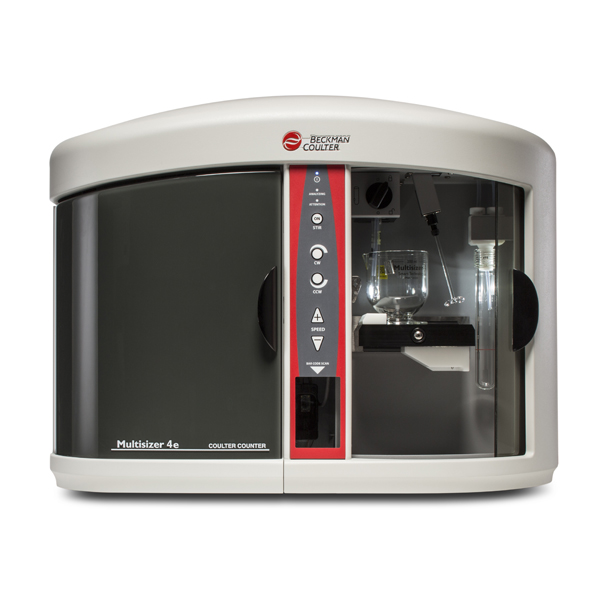
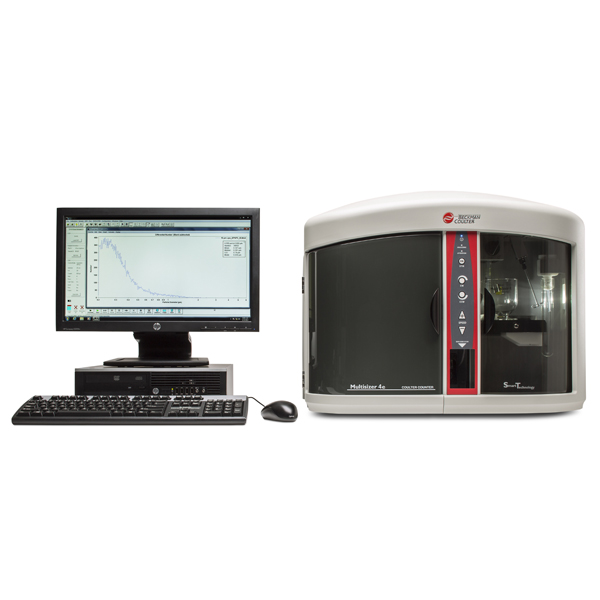
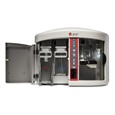
Multisizer 4e
Partikelzählung und Partikelgrössenbestimmung mit höchster Auflösung
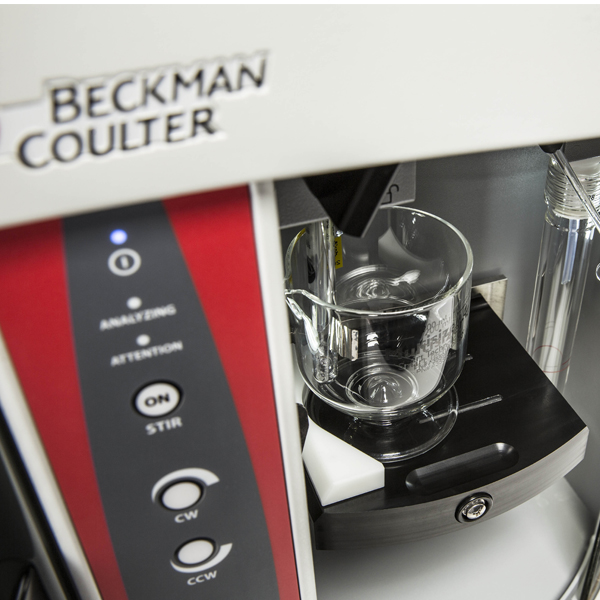
Mit der im Multisizer 4e eingesetzten "Digital Pulse Processor (DPP)" wird das klassische Impedanzmessverfahren (ISO 13319), erfunden 1953 durch Wallace Coulter, erstmals komplett digital umgesetzt. Damit sind Aufnahmeraten von über 500.000 Impulsen pro Analyse möglich. Auch lässt sich der dynamische Volumensbereich damit auf 1:64.000 ausdehnen.
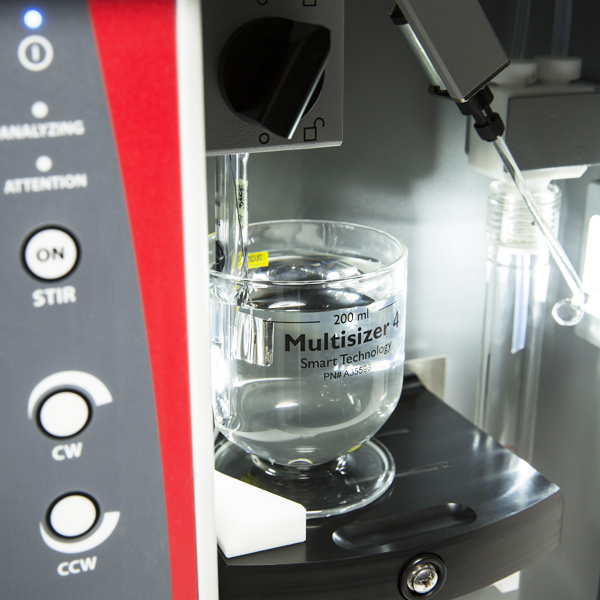
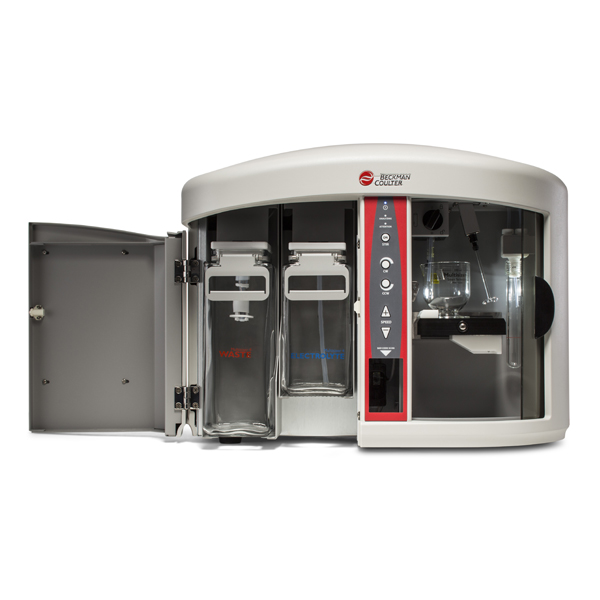
Selbstverständlich ist auch die Steuerung und Auswertung auf dem modernsten Stand. So wird das Messvolumen über eine Dosierpumpe bestimmt und sowohl die Messkapillare als auch der gesamte Flüssigkeitstransport durch Sensoren überwacht.
So lassen sich die Vorteile des Impedanzmessverfahrens, wie die dreidimensionale (form -und farbunabhängig) Betrachtung der Partikel und die extrem hohe Auflösung ideal mit einer modernen Bedienung (sogar Barcodeleser) kombinieren.
Die Multisizer 4e Software ist 21 CFR Part 11 konform und bietet auch diverse andere Qualitätssicherungsmerkmale, wie SOP's oder Validierungspakete.



Eigenschaften
Geräteeigenschaften
- Messbereich: 0,2 – 1.600 µm (Durchmesser)
- Dynamischer Bereich: 2 - 80% der Kapillaröffnung (Standard: 2 -60%)
- Max. Zählrate: 500.000 Partikel
- Min. Analysevolumen: 50 µl oder 0.1 Sekunde
Digital Pulse Processor
- Ermöglicht die komplette Aufzeichnung aller Impulse in digitaler Form
- Zusätzliche Auswertung der Impulsbreiten- und Höhenverteilung
- Aufnahme der max. 500.000 Impulse in Echtzeit (Verläufe)
- Nachträgliche Neuberechnung der Partikelverteilung
Software
- Darstellung von Anzahl-, Oberflächen- und Volumensverteilung (absolut, /ml, %)
- Verwendung von horizontalen, vertikalen und Bereichs-Cursors
- Automatische Steuerung über SOP’s
- Direkte Darstellung der Impulse (Breite, Höhe, Anzahl) möglich
- 21 CFR Part 11 konform , V-Check Programm für SQ, DQ, OQ
Typische Anwendungen sind:
- Bakterien, Biotechnologie, chromatographische Materialien, diverse biologische Zellen
- Emulsionen, Filterablagerungen, Hefe, Impfstoffe, keramische Pulver, Kosmetika
- Pigmente, Polymere, Schleifmittel, Toner, Wasserkontaminationen, Wirkstoffe, Würzen
Explore Multisizer 4e Models
Technische Dokumente
Multisizer 4e Particle Analyzer
What is the Coulter principle for particle analysis?
The Coulter principle is a widely used method for particle size and count analysis based on electrical resistance. It works by suspending particles in a conductive liquid and passing them one by one through a small aperture with an electrical current applied.
When a particle passes through the aperture, it displaces its own volume of electrolyte, causing a momentary change in electrical impedance. This change is directly proportional to the particle’s volume, allowing precise measurement of particle size and concentration.
The Coulter principle is commonly used in particle characterization, cell counting (e.g., blood cells), pharmaceuticals, biotechnology, and industrial quality control because it provides accurate, reproducible, and number-based particle measurements.
What's a good way to measure particle size distribution?
A reliable way to measure particle size distribution is Electrical Sensing Zone (ESZ) analysis, also known as the Coulter principle. This method measures particles individually as they pass through a small aperture, delivering high-resolution, number-based particle size distributions across a wide size range.
Instruments like the Multisizer 4e Particle Analyzer apply this technique to provide accurate, reproducible particle sizing and counting for applications in pharmaceuticals, biotechnology, industrial materials, and research. The Multisizer 4e Particle Analyzer is especially effective when precise control, traceability, and true particle-by-particle measurement are required—making it a gold standard for particle characterization.
What is the difference between a Coulter counter and flow cytometry for cell counting?
A Coulter counter counts and sizes cells using the Coulter principle (Electrical Sensing Zone) by measuring changes in electrical impedance as each cell passes through a small aperture. This provides accurate, label-free total cell counts and true cell volume measurements, independent of cell color, shape, or optical properties.
Flow cytometry, by contrast, counts cells using light scatter and fluorescence as cells pass through a laser. It enables multiparametric biological analysis (e.g., surface markers, viability, phenotype) but typically requires fluorescent labeling and is more sensitive to optical and staining variability.
How to count particles regardless of their shape or color?
The most effective way to count particles regardless of shape, color, or optical properties is by using Electrical Sensing Zone (ESZ) technology, also known as the Coulter principle. This method counts particles individually by measuring changes in electrical impedance as each particle passes through a small aperture filled with a conductive liquid.
Because the signal is based on particle volume, not light scattering or imaging, ESZ analysis delivers accurate, label-free particle counting that is independent of particle shape, transparency, refractive index, or color. This makes it ideal for heterogeneous samples in biotechnology, pharmaceuticals, industrial materials, and quality control.
Instruments such as the Multisizer 4e Particle Analyzer apply this technology to provide precise, reproducible particle counts and size distributions across a wide size range.
